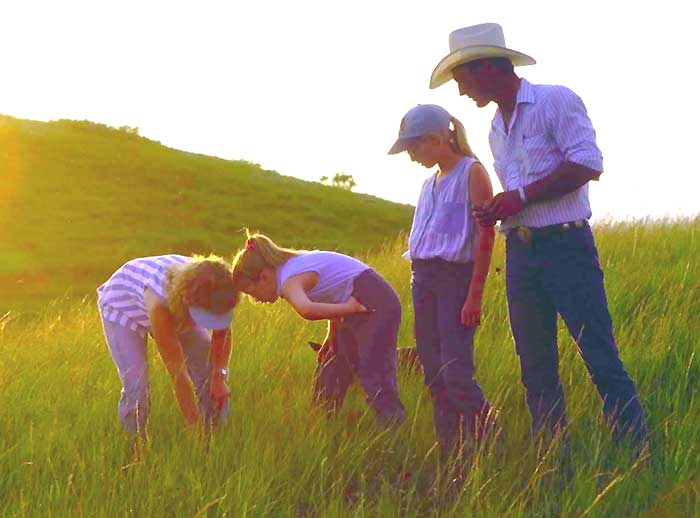
Olivia and Victoria Briggs help on their family’s New Hampshire dairy farm a few days a week during the school year and more in the summer. The sisters, 12 and 8 years old, milk cows, help repair fences and sometimes ride in tractors.
“It’s like a fair,” said Olivia, a sixth-grader. “Except every one of (the animals) is yours.”
But if parents Dana and Tiffany Briggs eventually incorporate Bo-Riggs Cattle Co. to protect the farm from liability, as countless other farming families have done, proposed U.S. Department of Labor regulations might prevent the girls from continuing much of their work here and on their grandparents’ farm. It’s work others have done for generations.
“Most everything we do today, I learned growing up,” said Dana Briggs, 36.
Agricultural child-labor rules haven’t been revised in about 40 years, and federal officials believed new technology and chemical use warranted the review.
The proposed rules, which run more than 50 pages, were released and opened to public comment in early September. The department received so much criticism that it pledged earlier this month to “re-propose” the regulations while accepting feedback for several more months.
The pushback is twofold: It revolves around what qualifies as a family farm, and what work is too hazardous for children. Federal law exempts from child-labor laws all children working on farms for their parents, even laws governing work considered “hazardous.” Those exemptions recognized “a parent’s natural concern for his or her child’s well-being will serve to protect the child,” according to the Labor Department.
But the new rules narrow who qualifies as a parent or surrogate; only under certain circumstances would a young person working on a relative’s farm be exempted.
“On my family’s own farm, our 15-year-old granddaughter would not be able to continue to help her grandfather in the milking parlor,” said Lorraine Stuart Merrill, New Hampshire’s commissioner of agriculture, whose family owns a 270-acre dairy farm in Stratham.
“It didn’t make sense,” she said. “We’re very concerned about the safety of our children and any employees and so forth, but that just didn’t make sense.”
Also, children or young adults working on family farms registered as a limited liability corporation or a partnership may not be exempted. “The current proposal … does not take into account the legal structure of modern farm ownership,” Sen. Jeanne Shaheen, D-N.H., wrote in a letter this month to Hilda Solis, the U.S. secretary of labor.
“It might be an uncle that actually owns the property, and the parents that are running it aren’t actually the owners,” said Chuck Souther, who owns Apple Hill Farm in Concord.
Rob Johnson, executive director of the New Hampshire Farm Bureau, offered another example: “If you had a partnership with your brother, how do (the children) fit into this?”
Generally speaking, work that may be off-limits to a teenager working in a store may not be off-limits for the same person working in agriculture. But agricultural work, the Labor Department argues, is among the most dangerous a person can find.
From 2003 to 2010, 74 percent of children younger than 15 killed on the job worked in agriculture, the Labor Department reports. Youths ages 15 to 17 who work on farms are four times more likely to be killed on the job than those working in any other industry.
The proposed regulations are littered with horrifying anecdotes of young people killed in accidents on farms.
Standing in a muddy hallway not far from the cows Olivia and Victoria had just milked, Tiffany Briggs, 35, needed no reminder of the risks.
Fifteen years ago, her 17-year-old brother was killed in a logging accident on her family’s farm. “The only organs they could donate was his eyes” because the trauma was so severe, Dana Briggs said.
Nothing in the proposed regulations could have prevented the death, the Briggses said, and no rule is more effective than their own determination to protect their children.
The proposed rules have also come under fire because they further restrict the work of teenagers who are not the children of farm owners.
If approved, the regulations would prevent people under the age of 16 from climbing ladders that are higher than 6 feet where a 20-foot restriction is currently in place. That could prevent them from working in haylofts and some orchards.
“They climb trees a whole lot higher than that,” said Jamie Robertson, owner of Bohanan Farm in Hopkinton, whose three sons and their friends have worked on his farm.
The regulations would also prohibit workers under the age of 16 from driving a variety of tractors and other heavy machinery, being in a stall with newborn calves, working inside a number of fruit storage units and using certain power tools.
Employers could be fined up to $11,000 for each youth-employment violation.
Such prohibitions are counterproductive, critics argue.
“They were restricting activities that are not all that hazardous,” Merrill said. “There’s great benefits for young people working and being involved in activities on farms. … They, in fact, can learn some things about good judgment and safe practices.”
The Department of Labor points out that nearly 18 percent of all deaths to the youngest agricultural workers involve the operation of a tractor. The proposed safety regulations would prohibit children under 16 from operating tractors that are more than 20 PTO horsepower and from using a variety of other large machines, such as corn or cotton pickers.
But Souther said some regulations, such as those prohibiting using a handheld device to check Facebook while driving a tractor or entering certain sealed refrigerated storage areas, would best be left to the already-required farm-safety manuals.
The proposed rules — which require no congressional approval — are written vaguely, Souther and others complain. What seems permissible in one section seems prohibited in another.
Also frustrating to some farmers is the belief that the new rules would strip young people of their ability to contribute to their families, learn a way of life and handle responsibility.
The Labor Department will likely release the revised proposed regulations in the early summer at regulations.gov. After that, the public will have 60 days to comment.
Until then, family farms will operate under the status quo.
(Contact Molly A.K. Connors at mconnors@cmonitor.com.)
(Distributed by Scripps Howard News Service, http://www.scrippsnews.com)
By Molly A.K. Connors
Concord Monitor staff
Tue, 02/21/2012 – 3:31pm
About Post Author