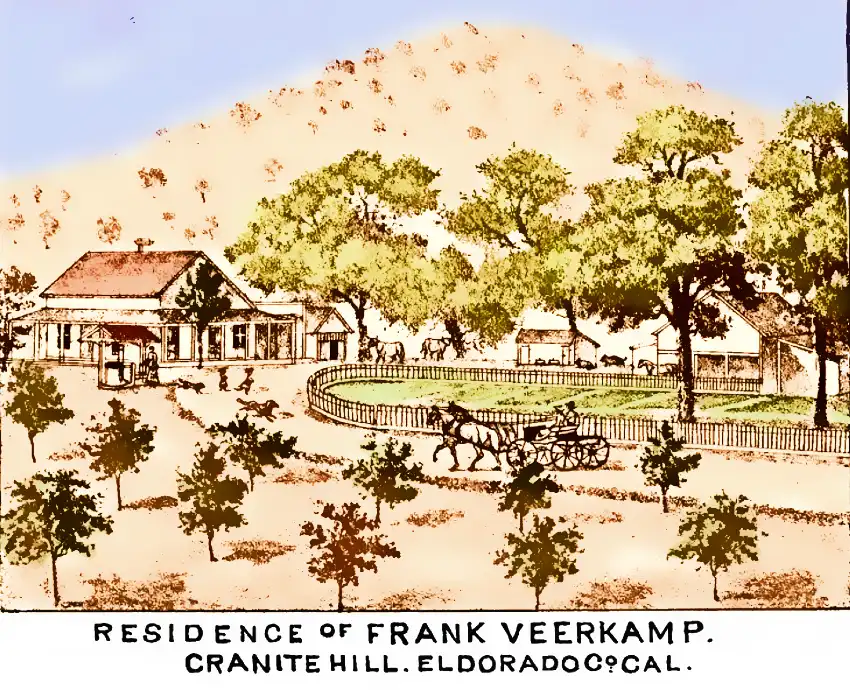
Roots of Resilience: The Veerkamp Pioneer Legacy in El Dorado County History
How One German Immigrant Family Helped Shape Agriculture and Preserve a Landmark of California’s First Japanese Colony
By [Cris Alarcon], El Dorado County History
EL DORADO COUNTY, Calif. — The story of El Dorado County’s agricultural breadth is inseparable from the narrative of pioneer families who laid down roots after the frenetic years of the Gold Rush. Among these, the Veerkamp family stands out for both entrepreneurial tenacity and long-term stewardship of one of the region’s most historically significant properties — the site of the Wakamatsu Tea and Silk Farm Colony.
A German Beginning and Gold Rush Arrival
Francis Joseph Arnold “Frank” Veerkamp was born on October 2, 1822, in Meppen, in the Kingdom of Hanover. As a youth he emigrated to the United States with his parents, settling in Ohio and later Missouri, where he apprenticed in merchandising before embarking for California in April 1852. He arrived in Placerville on September 6, 1852, and briefly operated a hotel and miners’ supply store in what was then Uniontown before establishing his homestead in the Granite Hill/Gold Hill district.
Farming and Community Development
In 1873, Veerkamp purchased roughly 340 acres of fertile foothill land — part of the area once known as the “Japanese Tea Ranch” — and transformed it into productive farmland with vineyards and orchards. The region’s rich soils and water access from local ditches supported diversified agriculture, reflecting a broader shift in the county from mining dependency to sustainable farming. Local place names like Veerkamp Way commemorate the family’s early influence on community identity and landscape.
Preserving a Cross-Cultural Landmark
A distinctive chapter in the family’s history began with the acquisition of the former Wakamatsu Tea and Silk Farm Colony site in 1873, following the colony’s collapse. Wakamatsu Farm was the first Japanese settlement in North America, established in 1869 by samurai-era immigrants seeking agricultural opportunity. The colony introduced mulberry trees, tea plants, and silk-related horticulture to California before drought, financial strain, and labor challenges led to its dissolution.
Despite the colony’s brief existence, one of its young participants, Okei Ito, became the first Japanese woman known to be buried on American soil when she died in 1871. The Veerkamp family cared for her gravesite and preserved key physical remnants of the colony for generations.
Legacy and Preservation
For over 140 years, the Veerkamp family maintained ownership of the Gold Hill Ranch, supporting agriculture and safeguarding its unique history. In 2010, the property was sold to the American River Conservancy (ARC) — a land trust dedicated to conservation and education — securing its status as a historical and cultural resource and facilitating restoration and interpretation of the farmhouse, gravesite, and landscape. “The Wakamatsu Colony story is every bit as compelling as the story of Jamestown or the Mayflower and Plymouth Rock,” ARC Director Alan Ehrgott said, underscoring its place in American immigrant history.
Today, Wakamatsu Farm serves as a focal point for community engagement with El Dorado County’s layered historical tapestry, offering educational tours, cultural events, and agricultural programs that honor both the pioneering spirit of families like the Veerkamps and the diverse narratives woven into this landscape.
- Francis (Frank) Veerkamp: The family patriarch who settled in El Dorado County in 1852. He and his wife, Louisa, were instrumental in the transition of the Gold Hill Ranch from a failed Japanese silk colony to a successful mixed agricultural farm.
- Bartholomew Veerkamp: A key early member who was heavily involved in local infrastructure, specifically the development of the Gold Hill Ditch system, which was vital for providing irrigation to the dry foothill ranches.
- Brian K. Veerkamp: A fifth-generation descendant who has served as an El Dorado County Supervisor (District 3) and fire chief for the El Dorado Hills Fire Department.
 The Veerkamp family is best known for their role in preserving the site of the Wakamatsu Tea and Silk Farm Colony, the first Japanese settlement in North America.
 - Acquisition of the Ranch: In 1871, following the financial collapse of the Wakamatsu colony, Francis Veerkamp purchased the 272-acre property.
- Protectors of History: The family provided employment and care for the remaining Japanese colonists, including Okei Ito, the first Japanese woman buried on American soil. They protected her gravesite on their property for over a century until the ranch was sold to the American River Conservancy (ARC) in 2010 for long-term preservation.
- Agricultural Production: The family operated the Gold Hill Ranch for 125 years, producing dairy, pigs, chickens, and fruit.
- Historical Records: A collection of their personal history, including transcriptions of family life and photographs, is preserved in the Veerkamp Family Papers.
- Civic Service: The family has a long tradition of public service; Brian Veerkamp’s great-great uncle, John Wagner, also served as a county supervisor from 1919 to 1934.

- Francis (Frank) Joseph Arnold Veerkamp (1822–1906): Born in Meppen, Germany; immigrated to the U.S. at age 12 with his parents, Bartholomew Veerkamp and Louisa Oelcker.
- Spouse: Married Louisa Sophia Catrina Tobener (1825–1899) in St. Louis, Missouri, in 1849.
- Children: They had 10 children, including:
- Henry B. Veerkamp (1851–1934): The only child born in Missouri; he later managed family agricultural interests.
- William Barthold Veerkamp (1861–1933): Born and died at Gold Hill; buried in the Pioneer Cemetery in Coloma.
- Louis Phillip Veerkamp (1871–1958): Married Mae Amelia Bergantz and had eight children, including Elwin Louis Veerkamp.
- The Brian Veerkamp Branch: Brian K. Veerkamp is a fifth-generation resident who served as an El Dorado County Supervisor. He is also related to the pioneering Wagner family through his great-great-uncle, John Wagner.
- The Doug Veerkamp Branch: Represents a major local business lineage through Doug Veerkamp General Engineering Inc. This branch continues the family’s deep ties to Placerville’s industrial and agricultural history.
- The Maurice/Kenneth Branch: Kenneth Lee “Ken” Veerkamp (died 2012) was a fourth-generation native and son of Maurice and Alice Veerkamp. This branch has extensive roots in the Rescue and Gold Hill areas.
- German Origins: According to the Veerkamp Family Papers, the family trace their roots to Westphalia, Germany.
- Bartholomew’s Unique History: Family records suggest the original Bartholomew Veerkamp may have been an abandoned infant of Jewish extraction adopted by Theodor Bartold Anton Veerkamp in Germany, which is why he is considered the genetic beginning of the current American line.
https://californiarevealed.org/do/21014d25-5652-4cef-9f5c-c892c5fb3f51
The 2001 oral history interview with Ada Veerkamp Niebower Rose covers her ancestral pioneer background, including her grandfather’s 1852 migration and role in developing the Gold Hill Ditch, and her personal life, detailing early 20th-century household chores like using a “gasoline iron”. The interview also discusses her education at San Jose State Teachers College and experience teaching in a one-room schoolhouse in the Coloma area. The full interview is available via California Revealed.
Oral history interview with Ada Veerkamp Niebower Rose,resident of Gold Hill, California
About Post Author