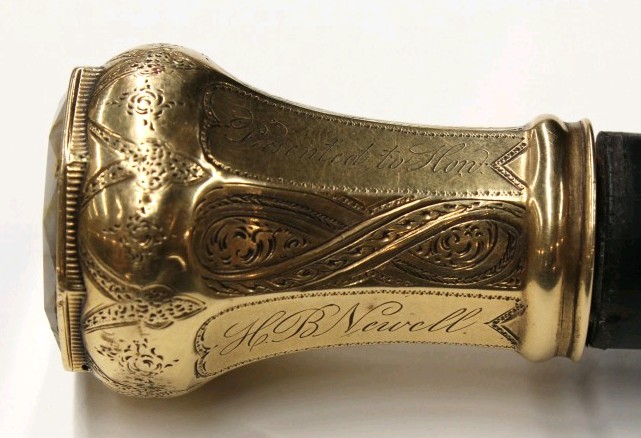
California State Assembly to Hugh B. Newell, a member of the assembly from 1867-1870 from El Dorado county
Cris Alarcon
From California history, a California Gold Quartz presentation walking stick which was presented by the Engrossing Clerks of the California State Assembly to Hugh B. Newell, a member of the assembly from 1867-1870 from El Dorado county sold for close to high estimate at $8,887.
The 1.25″ faceted octagonal cap of California gold quartz having highly figured veining centering the ornately chased, solid 14 kyg head with presentation inscription to H.B. Newell, from the Engrossing Clerks of the Assembly, the original ebonized shaft retaining the original tip and surface, Hon. Newell had vast land holdings in Gold Hill, one of the richest mining regions of the state, and Hon. Newell was also an officer of The Grand Lodge No. 92 in Coloma, CA. during the 1860’s, overall, 37″
The art of fashioning gold quartz into objects is unique to the western United States, primarily California. Gold quartz canes appeared at the time of the California Gold Rush, the years between 1848 and approximately 1864, although subsurface mines would continue extracting gold for another 20 years. According to an article appearing in The Mandel Cane Collection by Youssef Kadri, gold quartz canes were generally manufactured in two basic types, with a handle or knob, and a cartouche for engraving presentation information. Most gold quartz canes were presentation pieces. Although never mass produced, gold quartz canes were created as an expression of pride by individuals who were either directly or indirectly involved, but in either case came to profit from the enormous wealth generated by this turbulent and exciting time in our country’s history.
Gold quartz canes were often presented to friends and family, as well as dignitaries in the eastern states as symbols of California heritage and art.
About Post Author


